Skype us at scommerce.mage or call +44(0)1483 487746

Loading...

Magento 2 Order Tagger
£124.00
Compatible with Magento 2 community and enterprise 2.3.3 - 2.4.x including cloud edition
Magento 2 Order Tagger extension allows you to create and assign tags to specific orders hugely improving Magento’s order management system. Orders can be filtered based on tags allowing quick access to the variety of orders arriving at your store. New custom tags can be created using order attributes and can be managed from the dedicated order tags grid.
- Create and assign tags to orders
- Quickly and easily assign tags using the Actions menu
- Assign multiple tags to a single order
- Create Custom tags using Address and Order Attributes
- Ability to filter orders using specific tags
- Filterable order tags grid
- Comes with Predefined Tags
- Logs grid to keep track of assigned tags
- Compatible with HYVA Theme(NEW!)
- Compatible with Breeze Theme(NEW!)

Free Support
up to 60 days

Free Upgrades
up to 1 year

Fully open source
Product Description
Magento 2 Order Tagger
Compatible with Magento 2 community and enterprise 2.3.3 - 2.4.x including cloud edition
The Scommerce Magento 2 Order tagger extension gives you the ability to create custom tags and assign them to the specific orders making order management a breeze. Tags can be either assigned from the actions menu in the order grid or using combination of conditions while creating orders. You can assign multiple tags to a single order and use it to quickly filter or identify orders depending upon the requirement. Tags can be styled using the in built background color and text color properties allowing to create eye catching tags which are displayed in the orders grid. The default Magento’s order grid is enhanced with a new tag filter to filter orders based on tags assigned. You will be able to create an unlimited number of tags which can be viewed in a dedicated order tags grid with its standalone filter options.
Why Order Tagger?
Magento has an advanced order management system. However, even with its current capacity stores have dedicated teams for order management. The Magento 2 order tagger extension reduces that manual work and brings down the cost of operating your store. With the ability to create and assign a variety of tags, you will be able to filter orders based on a particular set of criteria. For example:- You want to filter out orders based on a particular payment method, or delivery method whose fulfillment needs to be prioritized. Another example could be you want to first process orders that exceed a certain subtotal value for which you need to search for orders that exceed this value. The module enables you to create a wide variety of tags using a combination of conditions based on address attributes and order attributes.
Order Tags Grid
- ✔ Integrates Order tags grid which keeps track of all the tags created.
- ✔ Create new tags or modify existing tags.
- ✔ Ability to delete tags from the grid.
- ✔ The grid can be filtered using a variety of filter options such as tag ID, Name, type, sort order, text color, and background color.

Create New Tags
- ✔ Easily create new tags and assign them priorities to decide which tag should be displayed first.
- ✔ Create static or dynamic tags.
- ✔ Static tags are manually assigned from the Actions menu.
- ✔ Dynamic tags are assigned based on set conditions.
- ✔ Define the text color and background color for the tag.
- ✔ Apply various conditions using Order attributes and Address attributes.

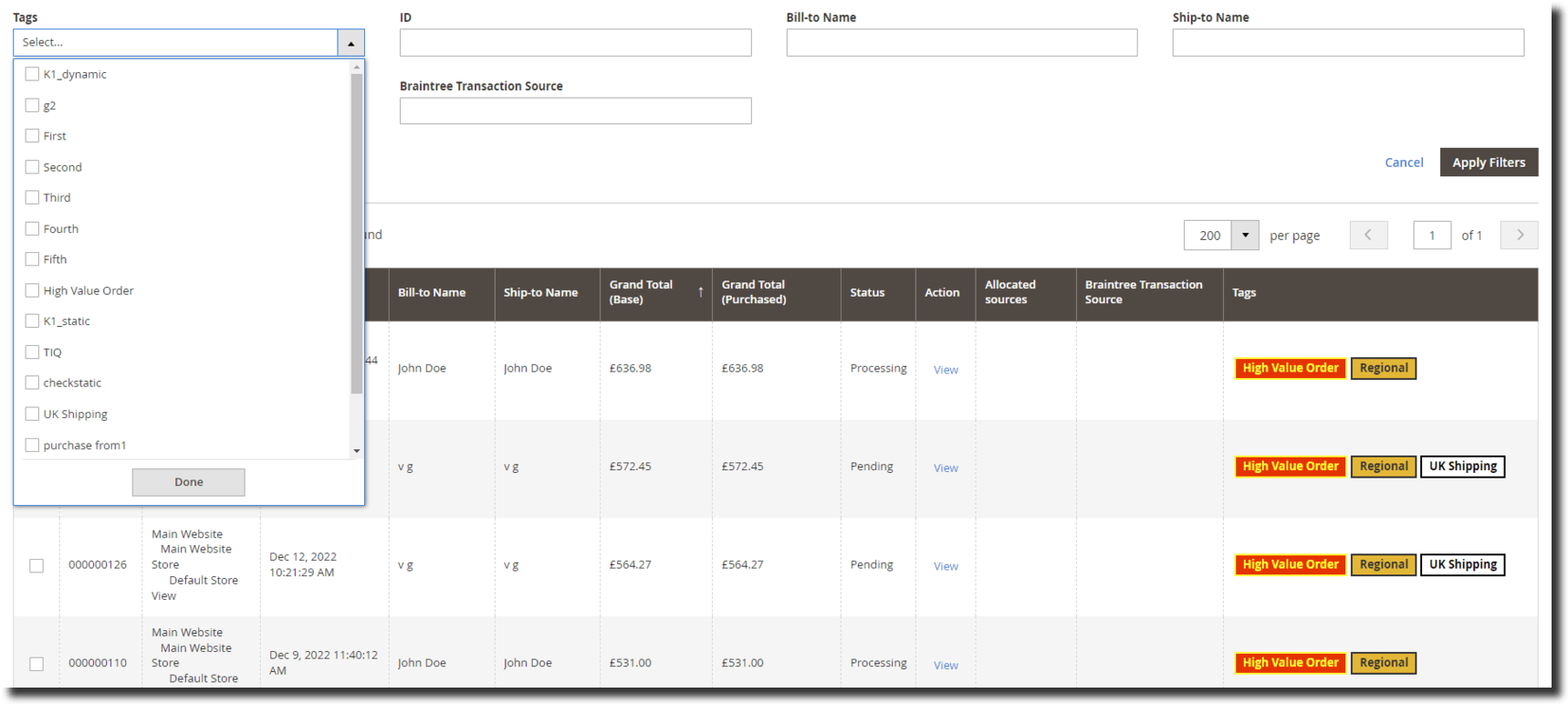
Add multiple tags to a single order and filter orders using tags
- ✔ Multiple tags can be assigned to a single order.
- ✔ The tags will be displayed in the order grid based on the tag priority.
- ✔ New filter option has been added in the grid to filter orders based on tags.
Manually assign tags from the Actions Menu in the order grid
- ✔ New options added in the Actions Menu to add tag and delete tag.
- ✔ Manually add tags to single or multiple orders by selecting orders from the order grid.

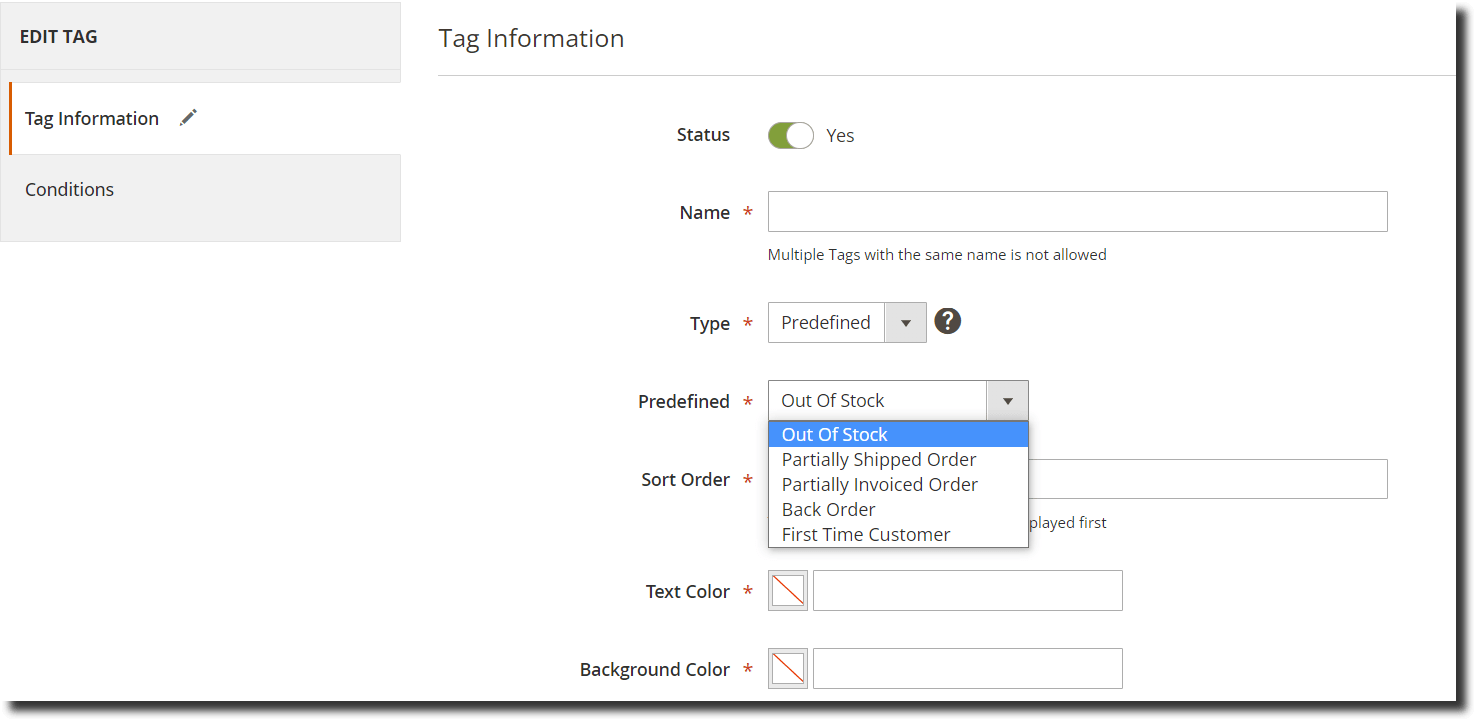
Comes with Several Predefined Tags
- ✔ First Time customer
- ✔ Partially Shipped Order
- ✔ Partially Invoiced Order
- ✔ Back Order
- ✔ Out Of Stock
Here are the main features of this module-:
- Improves Magento’s out of the box order management system providing flexibility.
- Ability to create, design, and add tags to orders.
- Multiple tags can be assigned to a single order using conditions.
- Add or delete tags from the Actions menu in the order grid.
- It comes with several predefined tags out of the box.
- It gives you the ability to create custom tags using order or Address attributes such as payment method, shipping method, status, shipping region, and more.
- Dedicated filter option in the Filters menu allowing you to quickly search or access orders associated with tags.
- It adds order tags grid to create or manage all of your tags. The grid can be filtered using several options such as tag id, name, sort order, background color, and more.
- It adds order tags logs grid as well which keeps track of all the tags assigned to specific orders.
- The tags can be easily styled using the inbuilt option to change the background and text color.
- Support multi-store environment
- User- friendly admin interface
- Compatible with HYVA Theme(NEW!)
- Compatible with Breeze Theme(NEW!)
- Ability to enable/disable this module from the admin configuration
- Easy to install and manage
We offer 60 days of free support and 12 months of free upgrade for any standard Magento site when you buy this extension. You can also get our installation service for a small fee. If you want more benefits, you can purchase our 12 months of free premium support and free lifetime upgrade package. Please contact us if you need any assistance or customization for this extension. We will reply to you within 48 hours. We may also offer you a special deal or a free solution if we like your idea.
** Please refer to our FAQ or T&C section for running our extensions on multiple domains or sub-domains
FAQ
Frequently Asked Questions
Q: How are static and dynamic tags seen on orders after creation?
A: Firstly, we need to create both tags from Sales>Order Tags (under Scommerce Order Tagger) and then after the creation, the dynamic tag will be shown automatically on orders that satisfy the condition of that tag. As for the static tag, the user needs to add them manually from Sales> Orders> Select All/Select on this page/Select individually(for a particular order)>Action> Add Tag, and tags will be seen after that. NOTE- Similar logic/steps are followed if the user wishes to delete a tag.
Q: How does Order Tags Logs work?
A: First thing that should be kept in mind is that Order Tags logs do not work for static tags. Regarding the dynamic tags, let's say we have a tag that has Tag id 1, which totally depends upon the position of that tag on creation, and this tag satisfies multiple orders but we make a change in it and now it satisfies only one order then this value Tag ID 1 will be seen in the logs. Also, when we create a tag id and it satisfies multiple or single orders then it will be shown in the logs Similarly, if we create an order then we will see its order ID and when we make any kind of changes in that order for eg we change its status then we will see the order id again. We will never see tag ID and order ID together for one log together. There are four statuses in logs-> pending, processing, complete, and failed, which will be seen only when there is some kind of an error.
Q: Can I add images to the tags?
A: No, currently images can not be added to the tags but we might be bringing this feature in the future updates.
Q: Can I create a single dynamic tag that satisfies multiple orders but for different conditions?
A: Yes you can, our module supports the functionality of adding multiple conditions in a single tag. It also gives the admin a choice between 'all' and 'any' i.e. admin can choose whether they want to make a tag that is only shown when all the conditions are satisfied or they want to make a tag that is shown when any of the conditions are satisfied and this will be useful when user wants to create a tag which satisfies multiple orders but for different conditions. 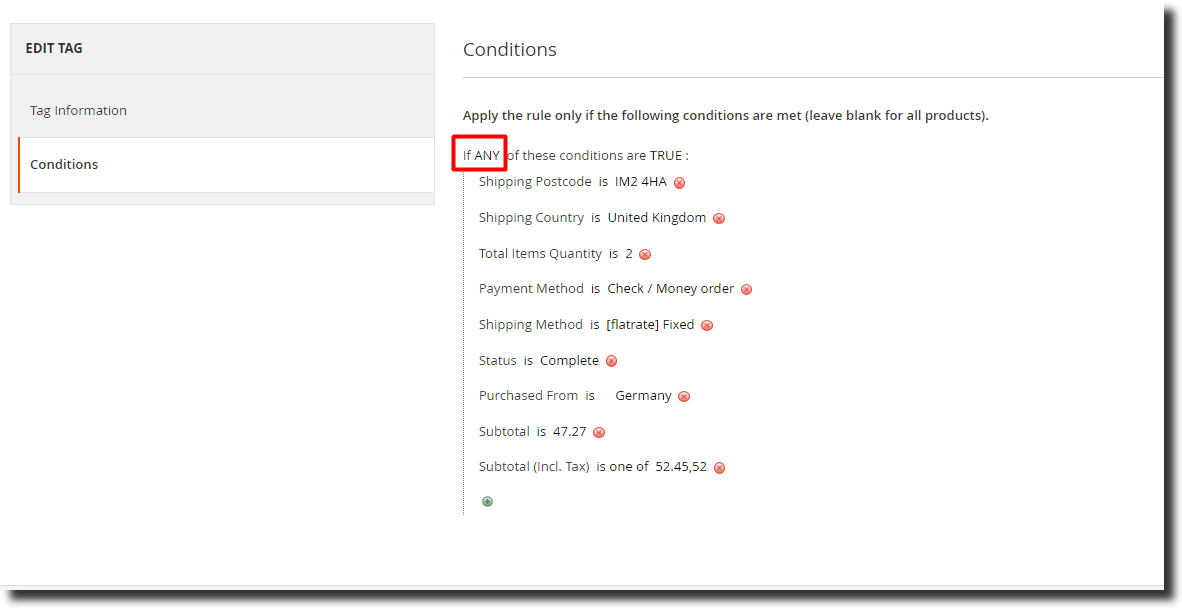
Q: Can I change the type of tag after its creation?
A: No, you have to delete it and make it again.
Q. Is this module fully compatible with Hyva Theme?
A. Yes, the module is fully compatible with Hyva Theme.
Q. Is this module fully compatible with Breeze Theme?
A. Yes, the module is fully compatible with Breeze Theme.
Q: What is the difference between a dynamic tag and a predefined tag?
A: The biggest difference between dynamic and predefined tag is conditions. In dynamic tags we use condition/s, and according to those conditions, tags are applied on appropriate orders. As for the predefined tags, there are no conditions because they are already set. Second difference would be the number of tags that could be created in the case of dynamic as well as pre defined tags . Only one pre-define tag of one field could be created whereas no such thing exist in the case of dynamic tags( multiple dynamic tags could be created if their name is different)
Q: Can I add more predefine tags apart from the existing ones?
A: No, you cannot. The reason why you cannot is because in the pre define tags we have already set the conditions. and according to those conditions tags are shown in the order grid. So, in total we have five predefined tags :first time customer, partially invoiced orders, partially shipped orders, back orders, and out of stock orders. Only these five pre defined tags could be added to the orders. If you want to add any other tag then you should use dynamic tags, which depend upon the conditions.
Q. How can I get license key for my development website?
A. Please use the same license as live site provided with the order confirmation email on the staging site and ensure you have the latest version of scommerce/core installed i.e 2.0.9.
Once added go to Stores>Configuration>Scommerce Configuration>Core and click on verify. Once verified the license will start working on your staging site.
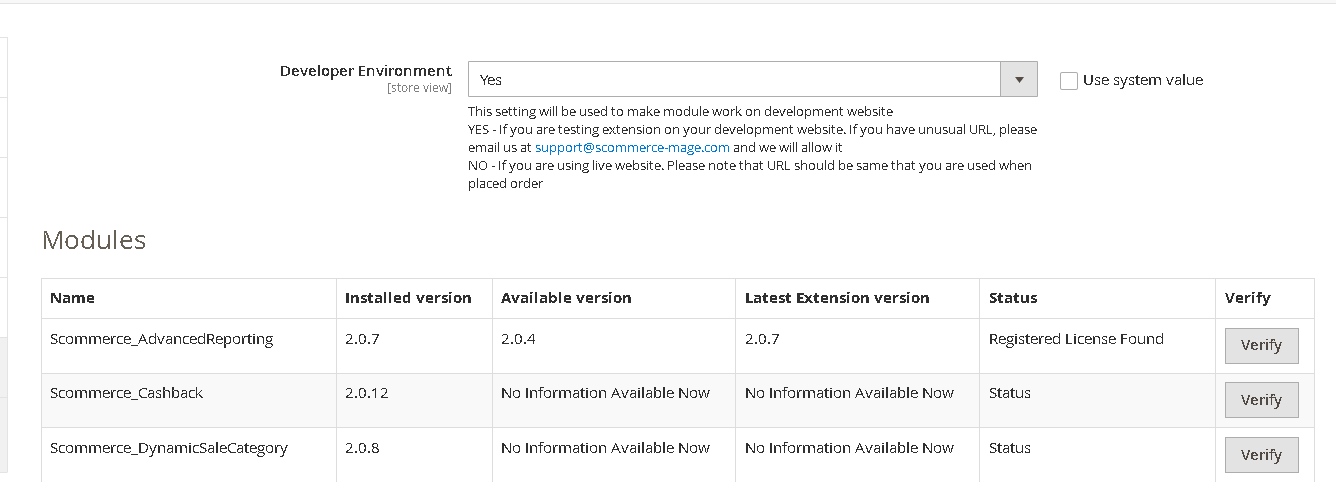
Once added go to Stores>Configuration>Scommerce Configuration>Core and click on verify. Once verified the license will start working on your staging site.
Q. Can I test the extension before buying?
A. Unfortunately we can't provide you extension for testing purposes but we have demo available for most of our extensions and happy to provide full refund if the extension doesn't work
Q. Can I request for customisation on your extensions?
A. Yes we do provide all sort of customisation for our clients at the reasonable rates. And if we believe the customisation will help our product then we also provide great discount on the customisation
Q. I have multiple websites/stores, each with a unique domain. Do I need a separate license key for each live domain?
A. Yes, each live domain requires its own license key. Our license keys are URL specific and each live domain, subdomain, subfolder requires a separate key. If you’re running multiple websites from the same Magento instance, we offer a 30% discount when purchasing license keys for two or more domains in a single order. To receive a coupon code, please contact us at support@scommerce-mage.com.
Q. How can I upgrade my extension to the latest version?
A. The upgrade process depends on your platform and how the extension was installed:
For Magento 2 (Installed via Composer)
If your extension is within the free upgrade period (12 months from the purchase date), you can update directly via the command line. Simply run the composer require command for the specific module to fetch and install the latest available version. If you are outside the free upgrade period, you will need to buy an upgrade using the link below.
For Magento 1 or Magento 2 (Installed manually via app/code)
If your extension is within the free upgrade period (12 months from the purchase date), you can simply download the latest available version by logging into our website and navigating to My Account > My Downloadable Products. If you are outside the free upgrade period, you will need to buy an upgrade using the link below.
Purchase an Upgrade:
https://www.scommerce-mage.com/magento-extension-installation-service.html
Important Note for Manual Upgrades: Before uploading the latest version, we highly recommend deleting all existing files and folders of our extension from your website. We may have deprecated or removed certain files in the update, and keeping the old ones could cause conflicts on your website.
Q.Where can I download the extension files?
A. Please login into your account on our website and go to the download link under my account section to download the extension package.
Q.Can you provide a key that works for our development (NOT PRODUCTION) environment which will work on a dynamic URL, for example, 12334.gitpod.com and 4567.gitpod.com?
A. Unfortunately it is not possible to generate license keys based on the dynamic URLs.
License keys need to be generated per domain or subdomain whether it is production or non-production.
Q. How can I manually uninstall your module?
A. Please follow the below steps -:
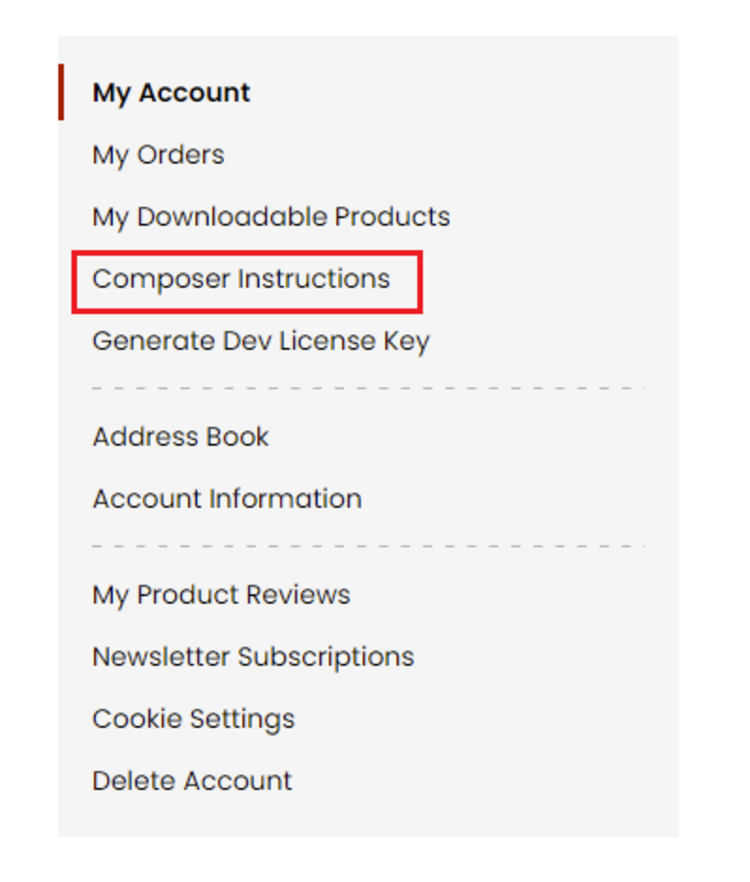
Step 1: Navigate to our store and login to your account. Then go to the My Account Section, on the left menu click on Composer Instructions.
 Step 2: Next, run the config commands shown on the top of the page then click on the extension that you want to install. A composer require command will be revealed in the dropdown menu. Run the command then clear caches to complete the installation.
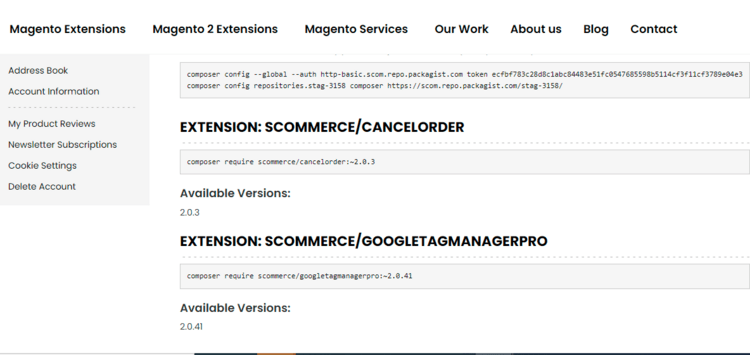
Step 2: Next, run the config commands shown on the top of the page then click on the extension that you want to install. A composer require command will be revealed in the dropdown menu. Run the command then clear caches to complete the installation.
Q. Do you support SPA (Single Page Application) / PWA (Progressive Web Application) / AMP ?
A. Unfortunately, we don’t support SPA or PWA or AMP but we may be supporting them in future depending upon the demand.
Change Log
Version 2.0.7
2026-04-30 12:26:16
Fixed an issue where the 'Select Tag' option wasn't showing up when manually assigning tags to orders from the Sales Orders grid
Version 2.0.6
2026-04-23 11:58:33
Code quality improvements, security and compatibility updates to support latest Magento 2 version and follow best practices and standards
Version 2.0.5
2025-08-12 09:46:25
Made it compatible with PHP 8.3 and Magento 2.4.8 version
Version 2.0.4
2024-12-30 08:12:59
Fixed duplicated tags issue
Version 2.0.3
2024-08-13 09:31:54
Made it compatible with Magento 2.4.7 and PHP 8.2
Version 2.0.2
2024-02-02 17:08:31
- Improved the performance and efficiency of processing new tags
- Solved a license key issue that affected static tags functionality
- Corrected a bug with the type field in the tag edit form that caused errors or inconsistencies especially when merging and bundling JavaScript is enabled in production mode
- Solved a license key issue that affected static tags functionality
- Corrected a bug with the type field in the tag edit form that caused errors or inconsistencies especially when merging and bundling JavaScript is enabled in production mode
Version 2.0.1
2023-01-17 13:43:33
Added new predefined type for tags
Version 2.0.0
2022-12-12 15:21:25
Initial Release
Show More
Show Less
Write A Review
Fields marked with * are required